

New FDA guidance marketing authorization decision point D
By Horacio M Pace-Bedetti, PhD, Principal Human Factors Engineer
Question this answers
What criteria does FDA Decision Point D use to evaluate human factors validation data?
Decision Point D evaluates whether human factors validation test data must be submitted based on user interface history of use, user interface complexity, and adequacy of existing risk controls. To support this pathway, manufacturers require robust objective evidence, including clean risk analyses, full traceability, known use problems, and connected post-market complaint signals.
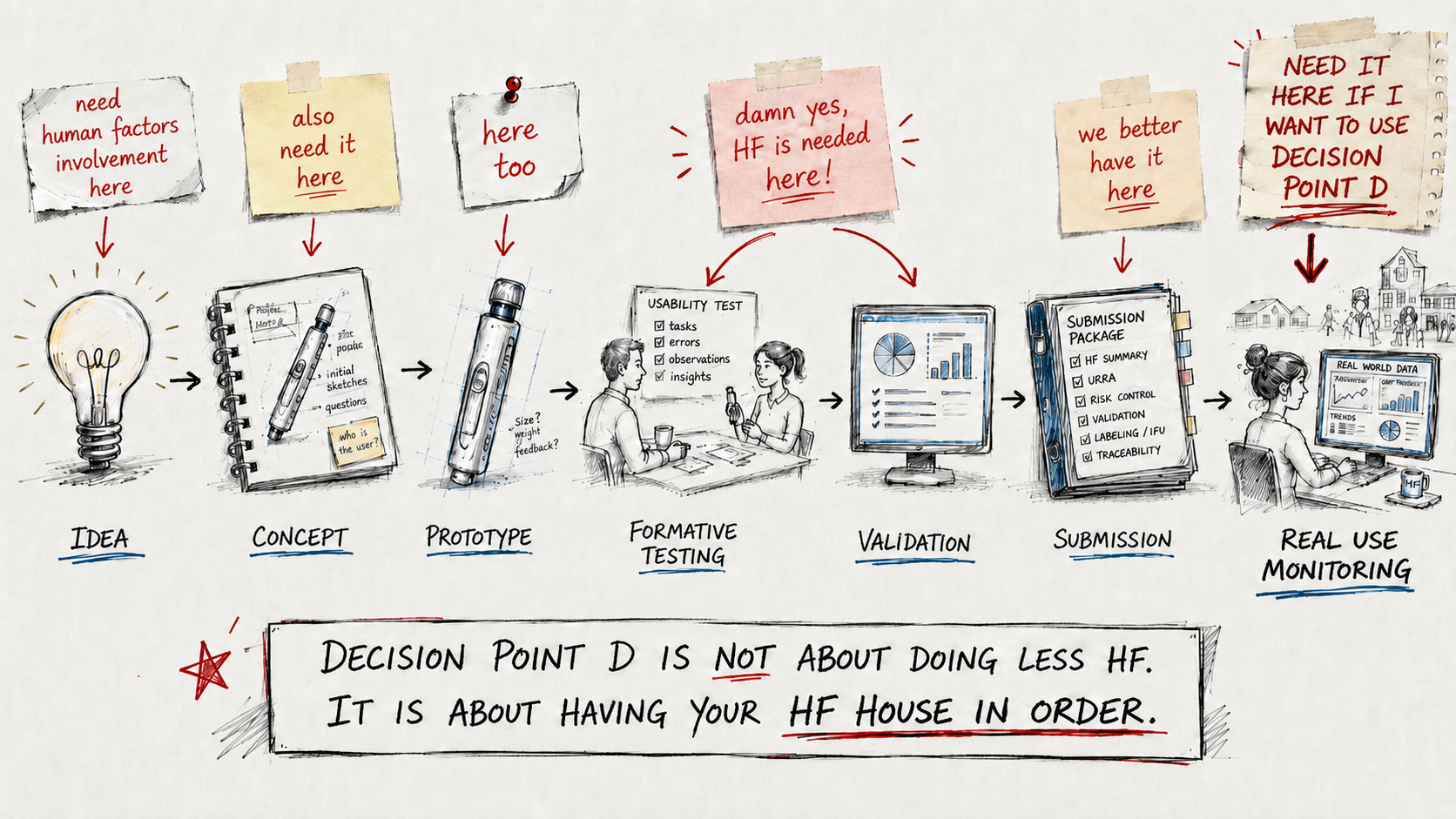
Decision Point D in the new Human Factors guidance from FDA is not a shortcut. It is a stress test of your Human Factors system.
Since FDA released the new guidance on Human Factors information in medical device marketing submissions, I keep seeing one interpretation: this will help companies skip Human Factors validation. But I think that misses the bigger point.
First, this guidance is not telling manufacturers how to run Human Factors. It is telling them what FDA expects to see in a submission. And if the rationale is weak, the Agency can still ask for more evidence.
One of the most critical parts, in my view, is Decision Point D. FDA is asking whether Human Factors validation test data need to be submitted based on three things:
- User interface history of use.
- User interface complexity.
- Adequacy of existing risk controls.
That sounds efficient. But to use that pathway well, you need objective evidence. You need a clean URRA. You need traceability. You need known use problems. You need complaint and post-market signals connected back to use-related risk. You need evidence that existing risk controls still work.
Many companies are not organized that way. Development HF lives in one place. Complaints in another. Risk files somewhere else. Lifecycle management runs on its own timeline. Then, when a modification comes, everyone tries to build the rationale retrospectively. That is not a shortcut at all, I can expect a lot of companies rather conducting additional validations that putting all that together.
The companies that will move faster under this guidance are not the ones doing less Human Factors. They are the ones that have kept their HF house clean across the full product lifecycle. Decision Point D is not FDA lowering the bar. It is FDA rewarding companies that can prove they never stopped doing the work.