
Critical task definitions
By Horacio M Pace-Bedetti, PhD, Principal Human Factors Engineer
Question this answers
How are critical tasks defined in medical device human factors?
Critical tasks are defined by consequence rather than difficulty, occurring when getting a task wrong could cause harm. For medical devices reviewed by the CDRH, critical tasks involve potential serious harm. For combination products reviewed by DMEPA, they cover any potential harm, including underdose, overdose, or missed doses disrupting treatment.
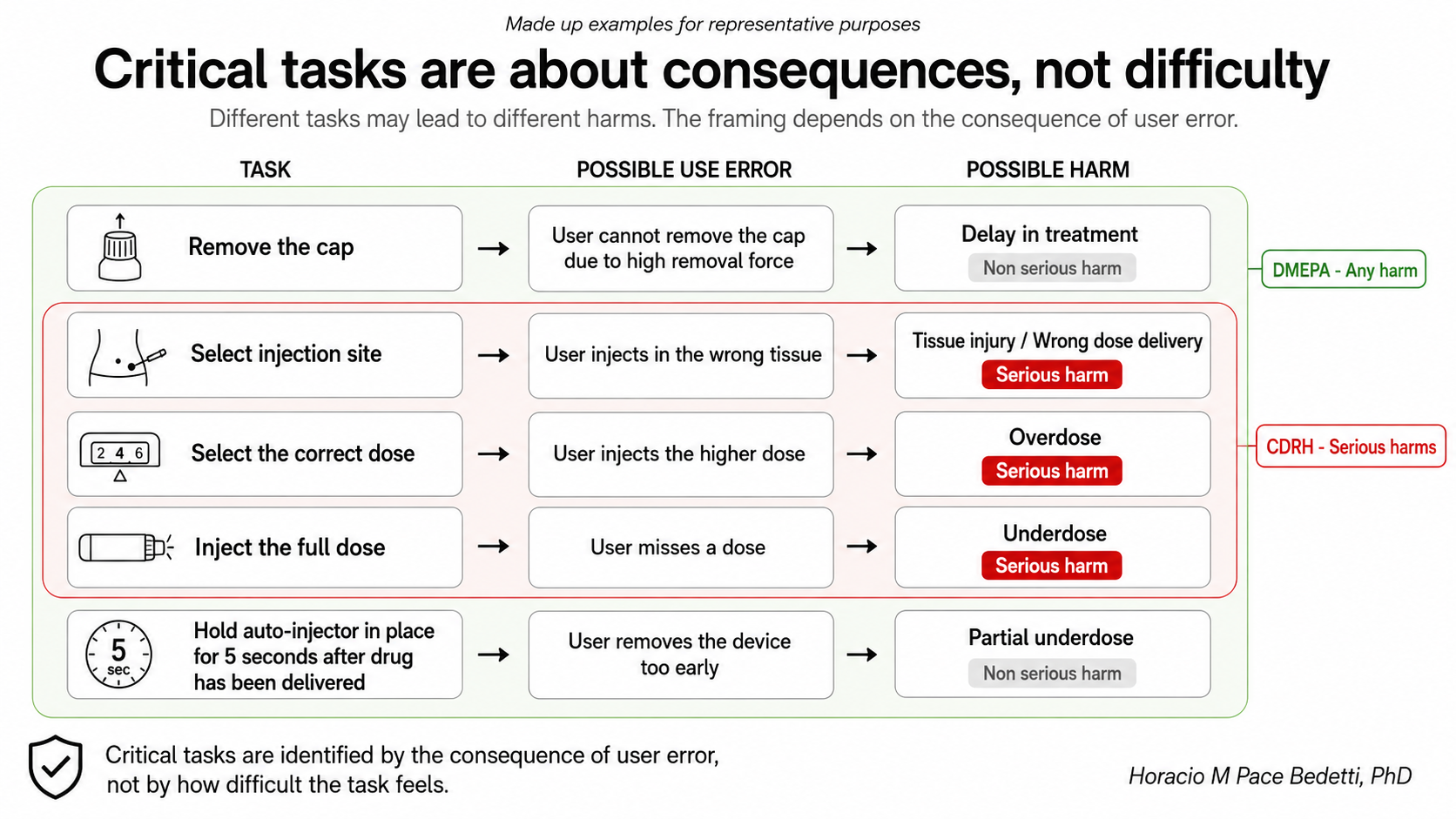
Critical tasks are not defined by difficulty. They are defined by consequence. A task becomes critical when getting it wrong could lead to harm.
ISO 14971 gives us the risk management backbone: hazards, hazardous situations, severity, probability, and risk controls. But it does not automatically tell us which user interactions need Human Factors evidence.
This is where critical tasks become useful. They help HF teams decide which interactions need closer attention, design effort, and evidence that the risk controls actually work for the intended users. Like a scoping tool 😊
For example, selecting the correct dose in an Pen Injector is not critical because it is complex. It is critical because setting a higher dose could lead to overdose.
One regulatory nuance is important here: FDA does not always frame critical tasks in exactly the same way across review centers.
For medical devices reviewed by CDRH, critical tasks are linked to the potential for serious harm.
For combination products, DMEPA takes a broader view. Critical tasks are linked to any potential harm, not only serious harm. Because the drug product is part of the risk picture, this can include use errors leading to underdose, overdose, wrong dose, missed dose, or other meaningful disruptions of treatment, even when they do not fit the usual serious-harm framing.
#humanfactors #medicaldevices #riskmanagement #regulation