

FDA guidance in human factors for medical devices from CDRH
By Horacio M Pace-Bedetti, PhD, Principal Human Factors Engineer
Question this answers
How does FDA human factors guidance differ from IEC 62366-1 for medical devices?
While IEC 62366-1 outlines the general usability engineering process, the FDA requires specific US submission criteria. Key differences include expecting at least 15 participants per user group, using US-resident participants, testing US-marketed labelling and training, providing explicit critical task analyses, and following a recommended structure for the human factors engineering report.
You cannot just say “we comply with IEC 62366-1” and assume FDA will accept your Human Factors approach.
IEC 62366-1 gives the usability engineering process. It tells you how to analyze, specify, develop, evaluate, and document usability as it relates to safety. But FDA looks at Human Factors through a US submission lens.
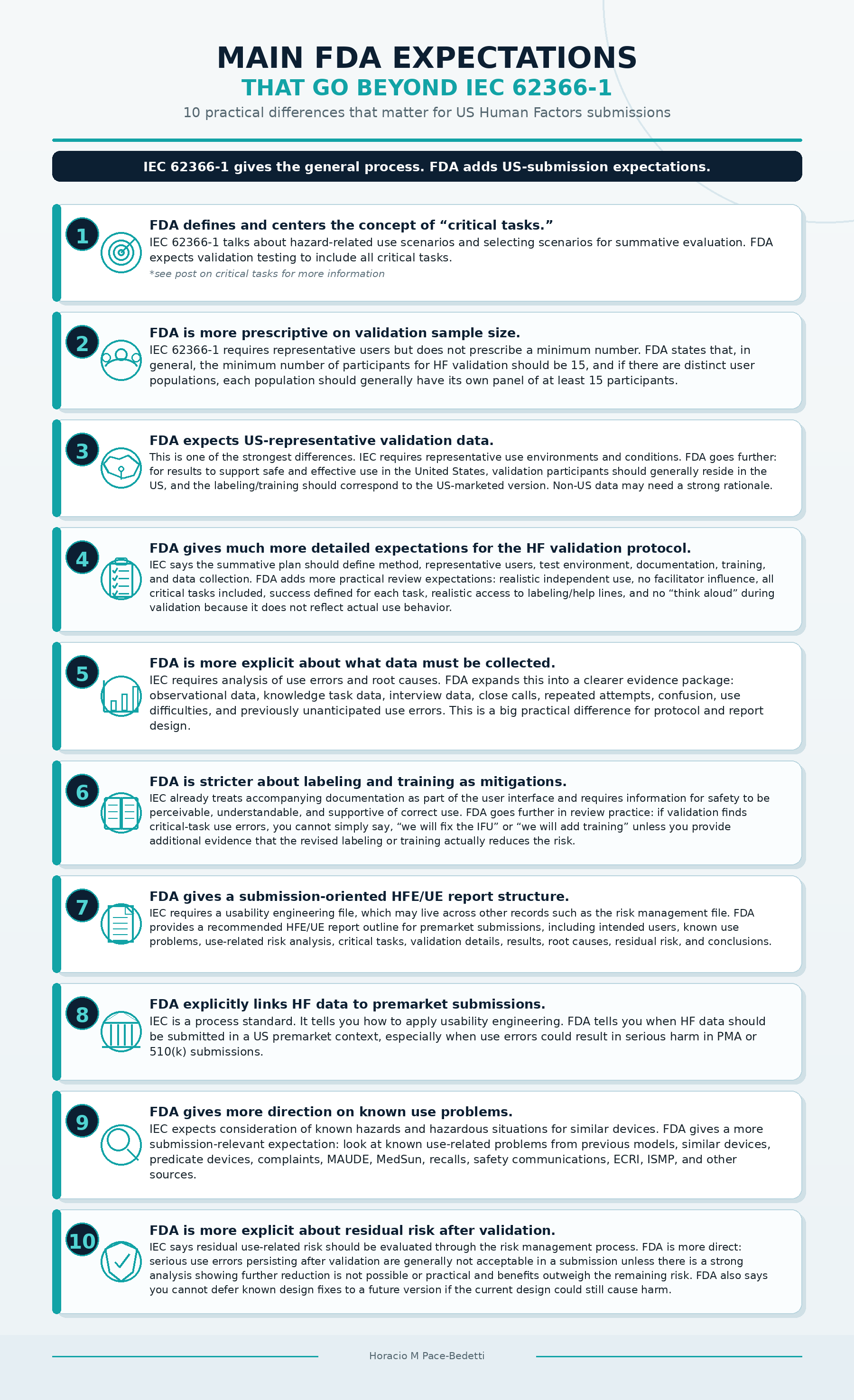
Some of the main differences are very practical. FDA is more explicit about critical tasks, validation sample size, US-representative users, realistic validation conditions, data collection, labeling and training mitigations, and the structure of the HFE/UE report.
For example, IEC 62366-1 expects representative users and use environments. FDA goes further. If the validation data are meant to support safe and effective use in the United States, participants should generally reside in the US, and the labeling and training should match the US-marketed version.
Sample size is another common one. IEC 62366-1 requires representative users, but it does not prescribe a minimum number. FDA generally expects at least 15 participants per user group.
Documentation is also different. IEC 62366-1 requires a usability engineering file. FDA have a recommended format and content they want to see in the HFE/UE report.
The picture below gives a more detailed description of the principal differences I see.
#fda #humanfactors #IEC62366