

Different regions different requirements but same goals
By Horacio M Pace-Bedetti, PhD, Principal Human Factors Engineer
Question this answers
How do medical device human factors requirements differ between the FDA, EU MDR, and NMPA?
The FDA evaluates whether intended US users can complete critical tasks safely, whilst China's NMPA scrutinises data transferability across local user characteristics and clinical practices. Under EU MDR, Notified Bodies increasingly demand rigorous usability evidence linked to safety and performance. Medical device teams must justify human factors transferability rather than assuming evidence applies globally.
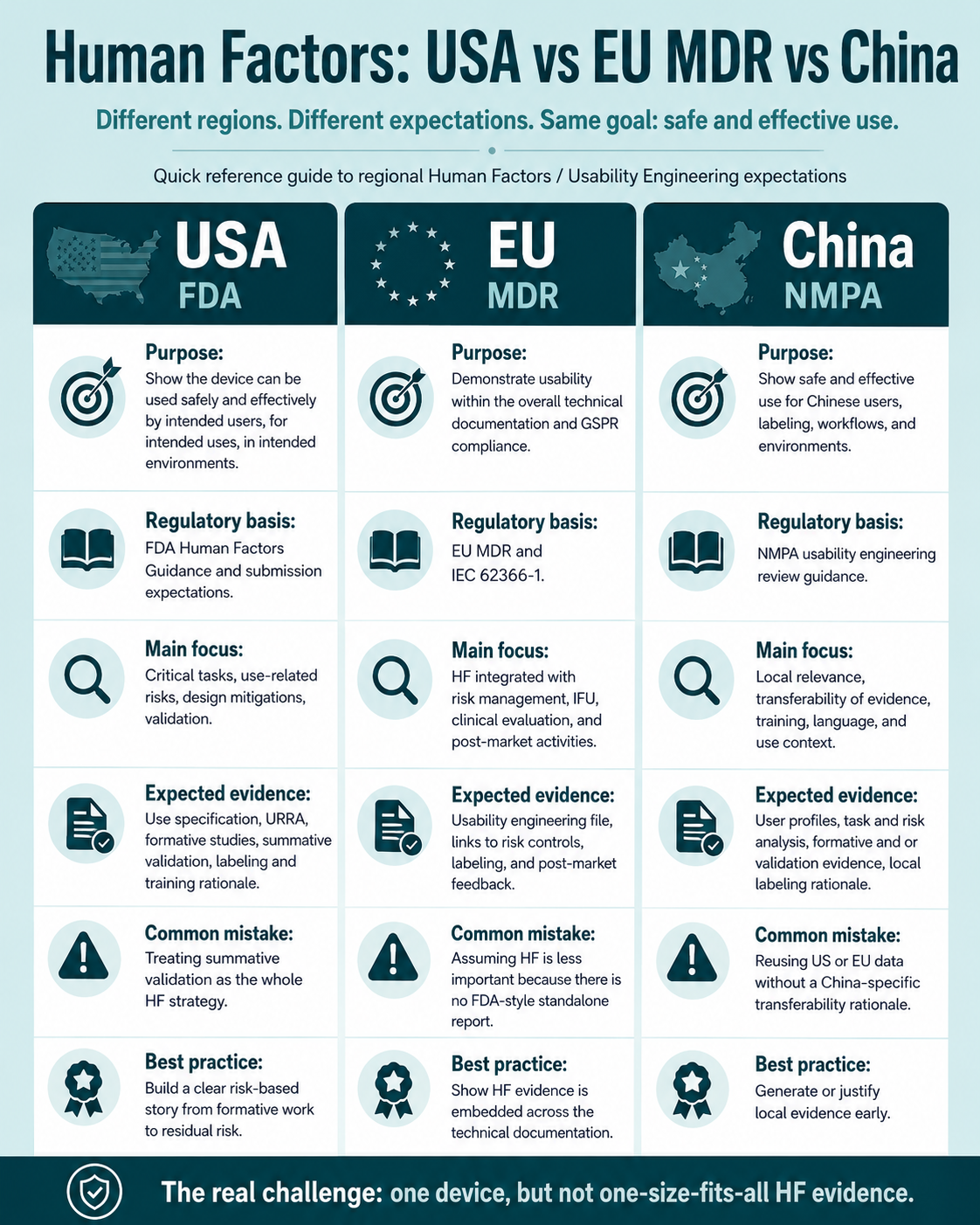
One device. Three regions. Three different Human Factors questions. The goal is the same everywhere, safe and effective use by real people. But the way evidence is reviewed, and what counts as “enough”, is not the same.
FDA tends to ask a very direct question: can the intended US users, in the intended US use environments, complete critical tasks safely and effectively? That means your HF story needs to connect users, use-related risk analysis, design mitigations, validation evidence, and residual risk. In China, the question shifts again. NMPA expects you to be careful when extrapolating data from other regions, because Chinese users, language, labeling, training models, clinical practice, and use environments may have unique characteristics that affect safe and effective use.
EU MDR has been different. Historically, Notified Bodies have not always challenged Human Factors with the same consistency or depth as FDA. But that is changing. More and more, they are getting up to speed and asking more specific questions about usability, risk management, IFU content, clinical evaluation, post-market evidence, and how Human Factors supports the broader safety and performance argument. This is where global teams get it wrong. “Same device” does not mean “same HF evidence.” Transferability has to be justified, not assumed. The strongest teams map this early and build one coherent usability strategy that can answer the right questions everywhere.