

IEC62366 methodologies in human factors
By Horacio M Pace-Bedetti, PhD, Principal Human Factors Engineer
Question this answers
Why should medical device teams not rely solely on simulated usability testing?
Relying solely on simulated usability testing means discovering usability problems too late, when design changes are difficult to justify. Applying varied IEC 62366 human factors methods earlier allows teams to understand users, workflows, environments, tasks, and risks beforehand. Selecting the appropriate method at each development stage prevents waiting until validation to address user struggles.
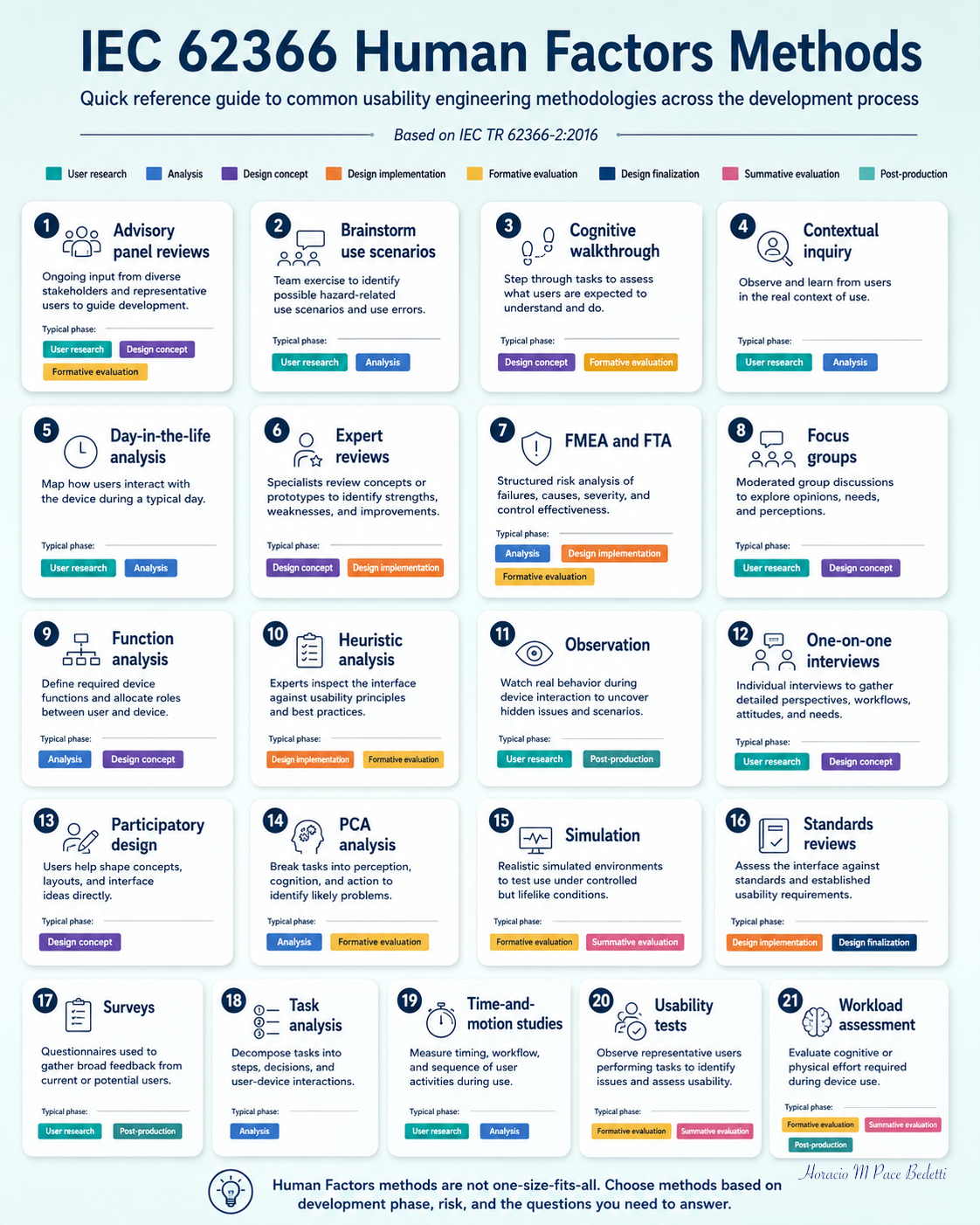
Too many medical device teams rely almost entirely on simulated usability testing.
Simulation can be very useful. But if that is the main way you discover usability problems, you are probably learning too late. By then, the design is already shaped, the team is invested, and every change becomes harder to justify.
The picture below shows some of the methods highlighted in IEC 62366. And even that is not the full toolbox. Human Factors has many ways to understand users, workflows, environments, tasks, risks, and design weaknesses before a simulated-use study.
The point is not to use every method. The point is to choose the right method for the right question, at the right stage of development. Strong HF work does not wait until validation to learn what users struggle with.
#humanfactors #usability #medicaldevices #IEC62366