
Different control measures and how it impacts
By Horacio M Pace-Bedetti, PhD, Principal Human Factors Engineer
Question this answers
What is the hierarchy of risk control measures for medical devices?
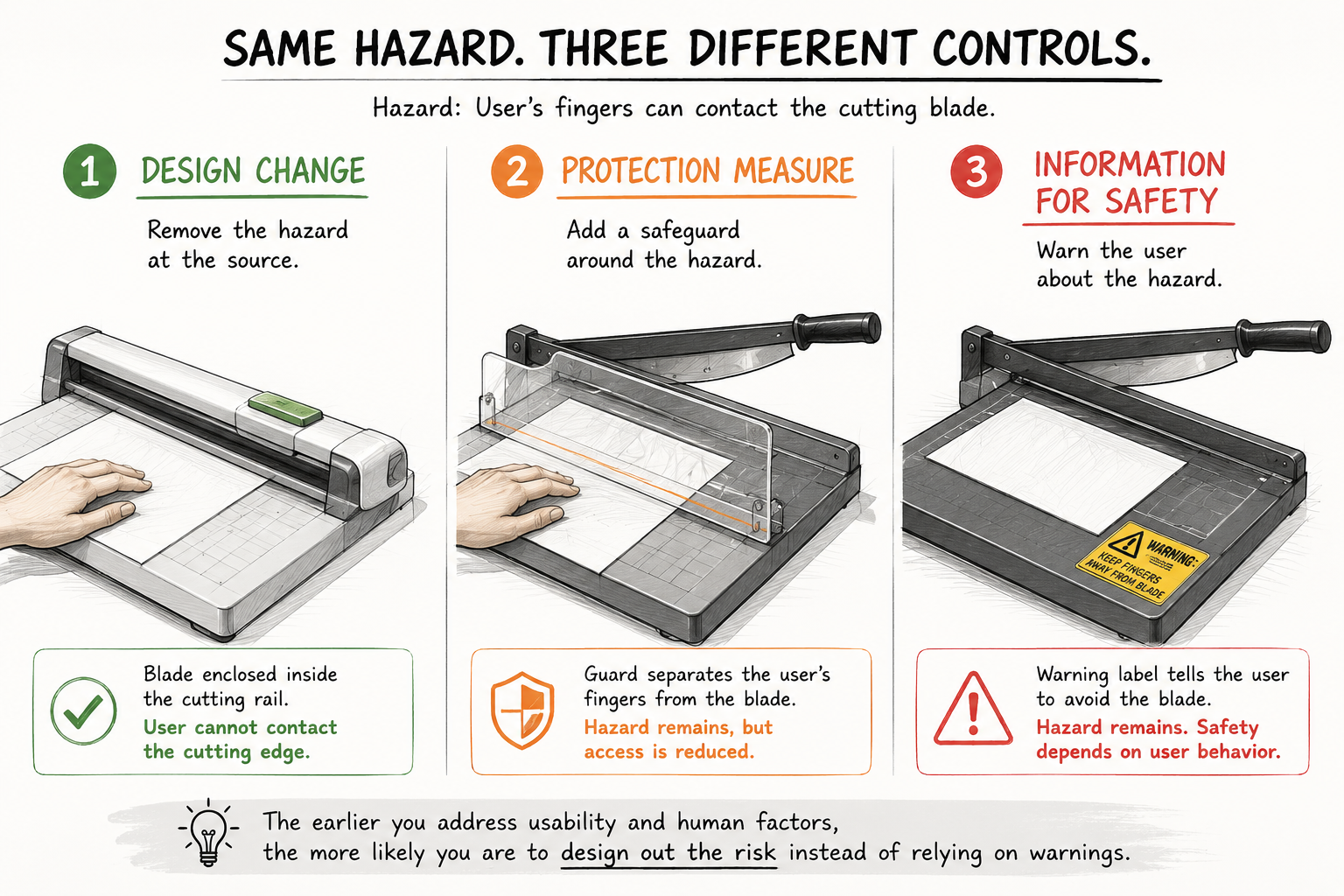
Under ISO 14971 and IEC 62366, the risk control hierarchy prioritises design changes, followed by protective measures, and lastly information for safety. Engineering out risks eliminates hazards directly. Protective measures reduce risk but leave hazards present, whilst information like warnings and instructions is the weakest control because it relies entirely on user behaviour.
A warning is not the same as a design change.
When it comes to risk control in medical devices, all control measures are not created equal. ISO 14971 and IEC 62366 both point to the same hierarchy: design changes, protection measures, and information for safety.
That order matters.
If you can engineer the problem out, you are removing the risk at its source. These are usually the controls that hold up best in both risk management and human factors reviews. In my experience, many of the issues that truly get solved in development are solved through a direct change to the product, interface, workflow, or use process.
Protection measures can also be effective. Alarms, interlocks, guards, lockouts, and similar controls can reduce risk. But the hazard is often still there. The protective feature has to work, activate, be noticed, or not be bypassed in actual use.
Information for safety is the weakest control. Instructions, labels, warnings, and training may be necessary, but they depend heavily on the user reading, understanding, remembering, and applying the information under real conditions.
That is a fragile place to put safety.
If you wait until your device is already developed to involve Human Factors, the opportunity to design out the risk may already be gone. What is left is often a warning, a label, or another sentence in the IFU. That may help, but it is rarely the strongest answer.
The earlier you involve Human Factors, the more chances you have to remove the problem from the design instead of asking the user to manage it perfectly every time.
#humanfactors #medicaldevices #riskmanagement