

Simulated vs. Actual Use Testing
By Horacio M Pace-Bedetti, PhD, Principal Human Factors Engineer
Question this answers
Can a clinical trial replace human factors validation testing for medical devices?
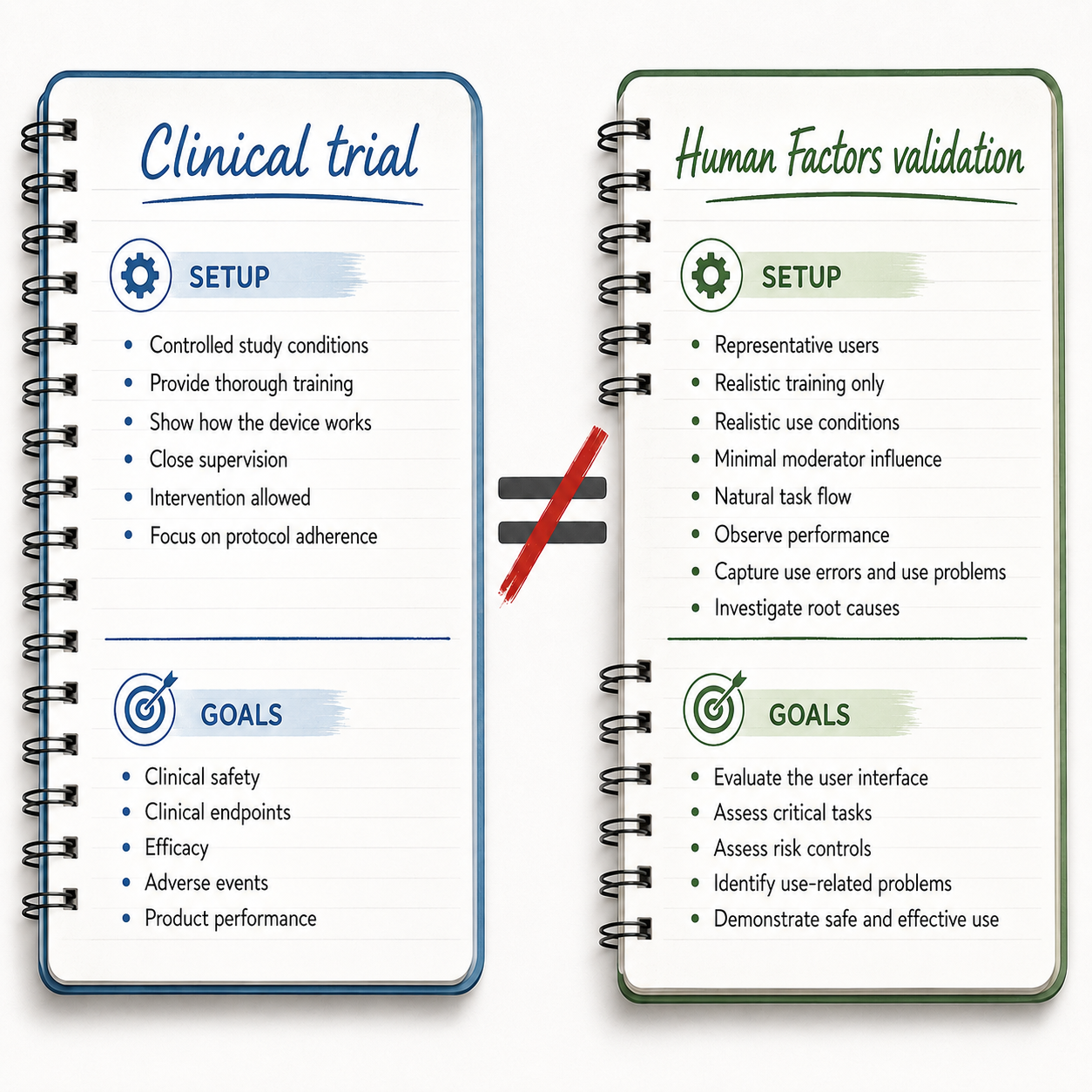
A clinical trial cannot automatically replace human factors validation. Clinical trials focus on therapeutic efficacy and clinical safety using tightly controlled conditions. In contrast, human factors validation requires representative users, realistic environments, and minimal investigator intervention to capture use errors. Blending them requires deliberately designing the protocol to meet specific human factors validation requirements.
Most human factors validation testing happens under simulated use conditions. Actual use validation is possible, and sometimes necessary, when simulated environments cannot replicate critical user interactions well enough. But a common mistake is assuming that running a clinical trial automatically checks the box for human factors validation.
The purpose of a human factors validation is to show that intended users can operate the user interface safely and effectively, without critical use errors. Clinical trials are fundamentally different, they aim to prove clinical safety and therapeutic benefit for patients. In drug studies, device use may be treated as a logistical hassle, not a true focus.
Methodology is another key difference. Human factors validation requires realistic scenarios, representative users, and minimal investigator intervention. The test design needs to reflect actual use as closely as possible, including realistic training, environments, and task flow. Clinical trials do the opposite, they emphasize controlled use and extra training to avoid variability, because the primary goal is validating what happens when the process is followed correctly.
This means you can merge human factors validation and clinical use, but only if your study setup also meets the requirements for validation: right users, realistic conditions, appropriate training, and careful capture of all use errors. Most clinical trials are not built for this, so shoehorning human factors objectives into a standard clinical protocol will usually not work for regulatory purposes.
If you plan on blending the two, start by mapping the study design against human factors validation requirements, not just clinical endpoints. If you skip this step, you risk missing regulatory expectations, even if you meet your clinical targets.